1.Background
The new round of the Israel-Palestine conflict has lasted for over a week, pushing international crude oil prices into an upward trend. On the 13th of October, New York oil prices saw a significant rise, with November delivery of New York light crude oil futures increasing by $4.78, closing at $87.69 per barrel. The future trajectory of oil prices has become the focal point of attention. While we cannot predict the future, all we can do is to prepare for it.
Due to fluctuations in oil prices, the importance of new energy has gradually gained more attention. According to statistics, in 2022, 5.35 million new energy vehicles were registered, accounting for 23.05% of the total number of newly registered vehicles, an increase of 2.4 million compared to the previous year, marking an 81.48% growth. With the fluctuation of global oil prices and the growing public awareness of energy conservation and environmental protection, new energy vehicles are becoming increasingly accepted, and the installation of charging piles is being rapidly promoted.
2.Hazards of Insulation Failure
As the new energy vehicle industry makes significant strides, issues related to the matching DC charging piles have gradually come to the forefront. Currently, the problems with DC charging piles include: car lock guns being difficult to remove, accessory failures, lack of network signal, insulation failures, etc. Among the most common electrical system risks are: insulation protection, DC leakage, DC arcing, and overcurrent protection.
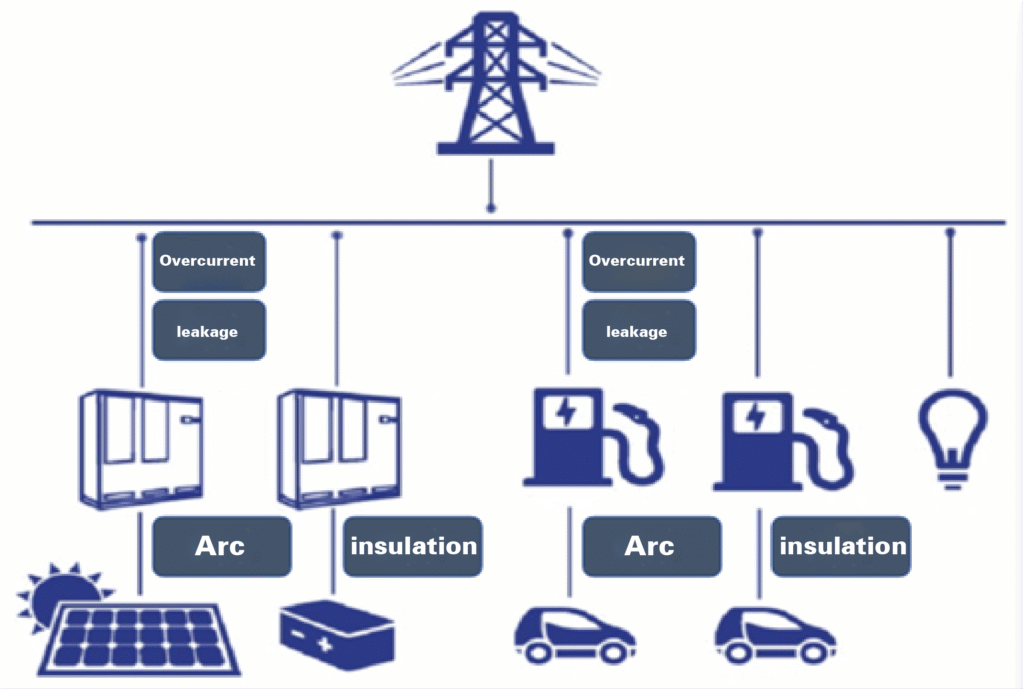
The insulation performance of the electric system in new energy vehicles and charging piles directly impacts their safety during use. Compared to traditional vehicles, the proportion of electronic and electrical systems in electric vehicles has significantly increased. Moreover, the power system of electric vehicles uses high-voltage systems that have never been employed in cars before, with voltage platforms reaching hundreds of volts. Therefore, electrical insulation is a critical component of high-voltage safety in electric vehicles. If there is an insulation failure in the electrical system, the consequences can vary depending on the severity. If insulation failure occurs at only one point in the system, it may not have an immediate noticeable effect. However, if multiple points of insulation fail, leakage currents can flow between the points, accumulating heat in nearby materials. Under certain conditions, this could lead to a fire. Additionally, it can affect the normal operation of electrical devices. In the worst-case scenario, it could result in electric shocks. Of course, since the electrical systems in vehicles are generally located in areas such as the chassis, which are not easily accessible to passengers, the risk of electric shock is primarily a concern for production and maintenance personnel.
Common causes of electrical insulation failure, apart from design and manufacturing issues, typically include: thermal aging, light aging, material brittleness in low-temperature environments, and frictional damage caused by improper fixation.
3. DC Leakage Detection in Electric Vehicle Electrical Systems and Charging Process
A pure electric vehicle is powered by a battery, which serves as the energy source for the system. The electrical system is a crucial component of the vehicle, as shown in Figure 1. The electrical system can be divided into low-voltage and high-voltage systems based on different uses. The low-voltage system uses a 24V DC power source, primarily providing power to the vehicle’s central controller, battery management system, lights, and wipers. The high-voltage system, which provides power to large components such as the vehicle’s drive motor, typically operates at a nominal voltage of 384V DC. This high-voltage system is powered by a traction battery (either lithium-ion or lead-acid), which primarily meets the power demands of the vehicle’s drive motor, power steering system, braking system, and onboard air conditioning system.
These electrical devices are all installed on the vehicle chassis, with each device having an independent current circuit and no direct electrical connection to the chassis. The entire high-voltage system is an insulated and enclosed electrical system, separated from the chassis.
When the high-voltage system is activated, it continuously charges the auxiliary battery via a DC/DC converter. Under normal conditions, the high-voltage system is a closed system, completely insulated from the vehicle body. However, issues like the aging of high-voltage cables may reduce insulation, leading to leakage currents to the vehicle body. Additionally, the electric vehicle operates in a complex environment where vibrations, temperature and humidity fluctuations, and exposure to acidic and alkaline gases can damage the insulation, causing a reduction in the overall insulation performance of the vehicle. The positive and negative terminal wires of the battery, through their insulation layers, form a leakage current circuit with the battery chassis, raising the potential of the chassis. This not only affects the normal operation of low-voltage electrical devices and ECUs in the vehicle but may also pose a safety risk to the driver and passengers. Therefore, a leakage current detection unit can be placed between the positive and negative terminals of the battery to perform insulation testing. As the voltage of the battery pack is usually between 400V and 500V, and in some cases, even up to 800V, insulation issues could pose significant dangers to the driver and passengers, and thus should be taken seriously.
Meanwhile, during the DC charging process, the DC charging equipment must first connect to the off-board charger. AC power is first delivered to the off-board charger, which performs AC/DC rectification internally, then delivers the rectified DC power to the electric vehicle’s battery, completing the charging process.
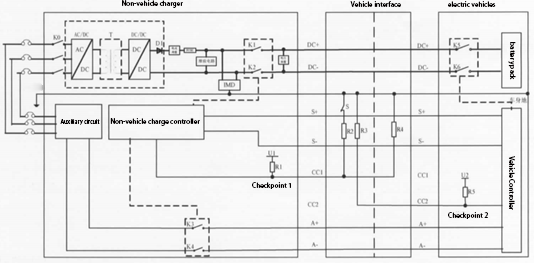
DC charging pile insulation detection involves measuring parameters such as resistance and current of the external circuits of the charging pile to assess whether the insulation of the charging pile is intact. Under normal conditions, there will be an appropriately thick layer of insulation material between the circuit wires and the charging pile’s outer shell to prevent leakage or short-circuit faults. When the insulation material is damaged or insufficient, the insulation between the circuit wire and the charging pile’s outer shell will fail, causing leakage currents or short-circuits, which can lead to dangerous situations. By adding DC leakage detection to both the DC charging pile and the off-board charger, insulation testing can be implemented, allowing timely identification of issues and preventing accidents.
In AC charging, the AC pile is directly connected to the on-board charger to complete the charging process. Although it is AC charging, it does not mean there is no risk of DC leakage during the process. As shown in the figure, the electrical system in electric vehicles operates on DC. Over time, insulation components degrade due to aging and repeated plugging/unplugging, which reduces the system’s insulation impedance to ground. This causes the vehicle’s outer shell and the external power supply to share a common ground, forming a loop. Consequently, a DC current component can flow through the loop and return to the charging side via the PE wire, increasing the risk of electric shock on the charging side. Therefore, DC leakage detection can be added to the on-board charger to implement insulation detection.

4.Insulation Detection Methods
Currently, the primary methods for insulation detection of charging piles are as follows:
(1) Bridge Method
In this method, the positive terminal, negative terminal, and ground line of the charging pile’s output DC power are each connected to an unbalanced bridge. Different resistance values are set between the positive terminal and ground, and between the negative terminal and ground. By adjusting the resistance to balance the bridge, the insulation resistance value can be calculated.


(2) Capacitance-Voltage Method
This method calculates the insulation resistance by measuring the voltage across the capacitor. The principle of the capacitance-voltage method is based on the relationship that the capacitance value of a capacitor is proportional to the applied voltage. A capacitor consists of two metal plates and a dielectric material. When voltage is applied to the two metal plates, the capacitor stores charge, forming a capacitance. When the measured voltage is applied to one side of the capacitor, the capacitance value will change with the variation in voltage. By measuring the capacitance value of the capacitor, the magnitude of the measured voltage can be determined.

(3) Low-Frequency Injection Method
The low-frequency injection method is a widely used insulation detection technique for electrical equipment. It is one of the most commonly applied methods for insulation monitoring. The working principle involves injecting a positive and negative symmetrical square wave signal into the tested equipment. By measuring the voltage drop across a sampling resistor, the insulation resistance value is calculated. During actual testing, the signals generated by the system contain both DC and AC components. The AC component is related to factors such as the system’s distributed capacitance and stray inductance, and the equivalent impedance characteristics of the system formed by various components also differ. These characteristics will vary with changes in testing conditions and environments. Therefore, the impedance characteristics of the system itself constantly change as the system operates, and the measured insulation impedance value exhibits dynamic characteristics.
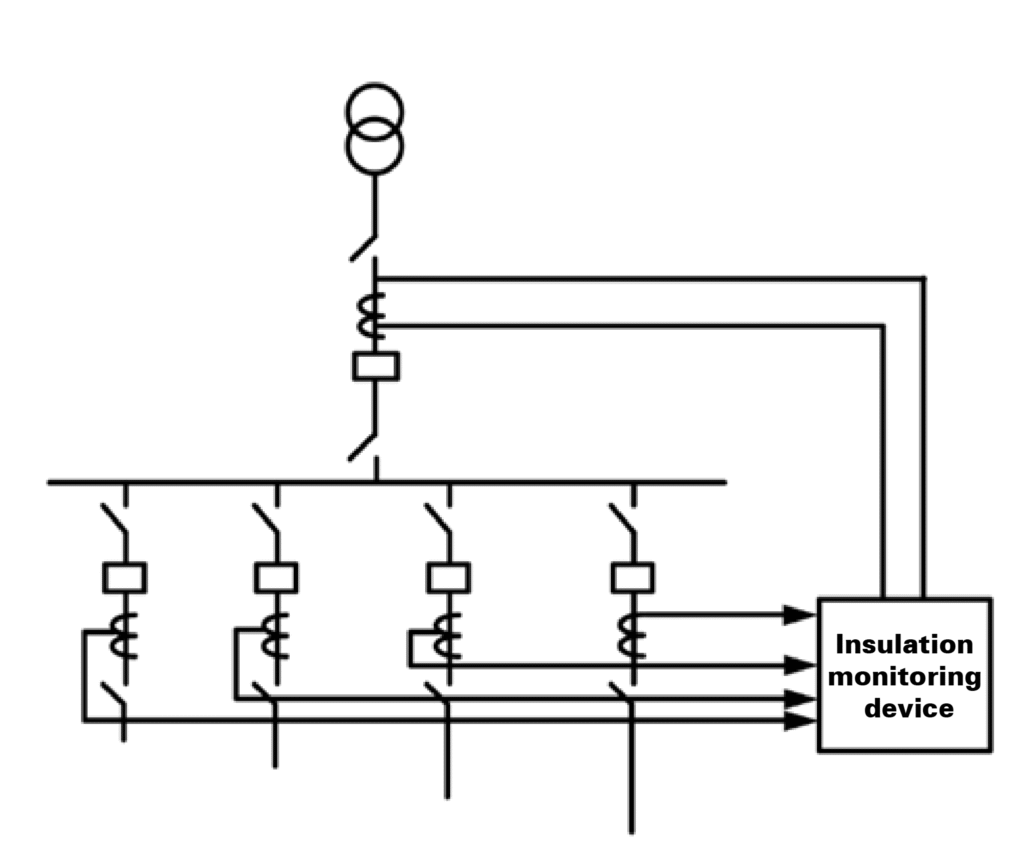
(4) Current Detection Method
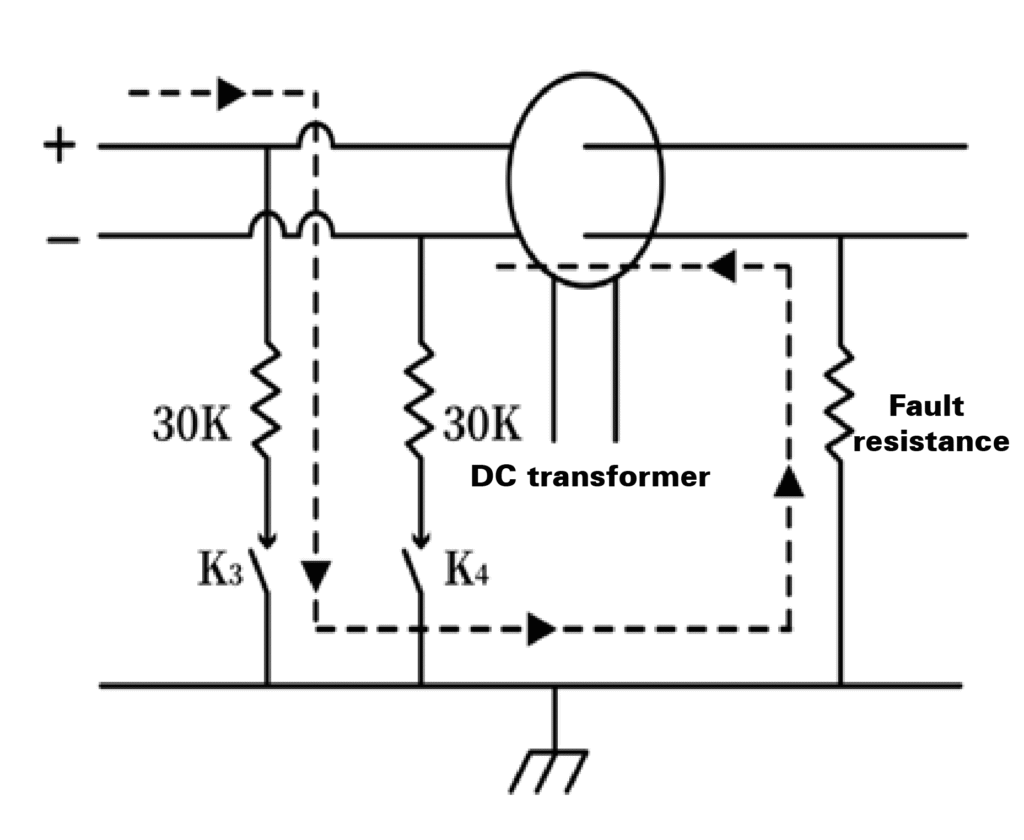
When insulation degradation occurs at one of the poles, the current between the positive and negative poles will no longer be equal. This current difference is sensed by a sensor, and the leakage current is then compared with the values calculated using two 30K resistors and two switch-controlled correction resistors. If the measured leakage current exceeds the alarm threshold, an alarm is triggered for the branch.
① Resistive Current Detection Method
The resistive current detection method is one of the most commonly used techniques. It involves placing a resistor in series within the circuit to measure the current. The larger the resistance value, the greater the voltage generated by the current, leading to higher measurement accuracy. The advantage of the resistive current detection method is its simplicity and ease of implementation; however, it can affect the operation of the circuit, so selecting an appropriate resistance value is crucial.
② Magnetic Current Detection Method
The magnetic current detection method measures the current size and direction based on the magnetic field generated in the circuit. When current flows through a conductor, a magnetic field is produced. By measuring the strength and direction of the magnetic field, the size and direction of the current can be calculated.
5. Insulation Detection via DC Leakage Current Detection
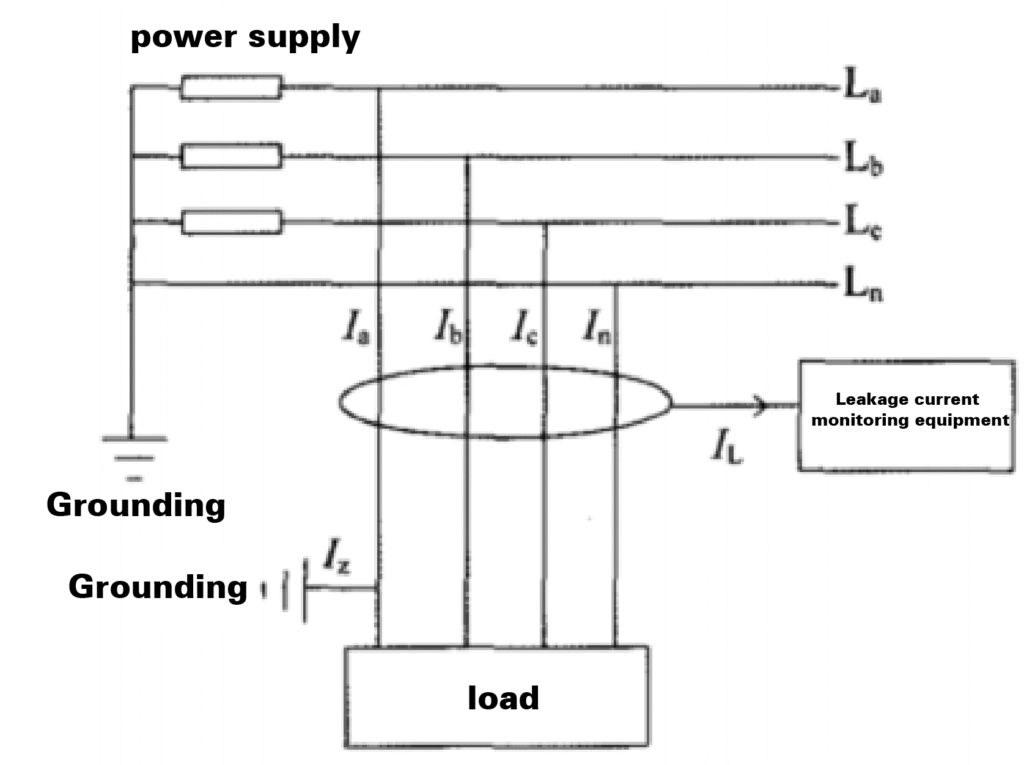
For the fourth current detection method, a more commonly used approach is detecting DC leakage current to achieve insulation monitoring. A leakage current sensor is specifically designed to detect leakage currents in DC systems. For example, in a three-phase system, an RCMU (leakage current monitoring unit) is placed on the bus bar, with the crucial point being that all three bus bars pass through the middle of the RCMU’s central line hole. If the system has no neutral line, it is a three-phase three-wire AC system. However, in a three-phase four-wire system, if no current flows through the neutral line, the neutral line does not need to pass through the RCMU.
Let’s assume a 10A load is connected to a 380/220VAC system. The RCMU will measure this simultaneously. According to Kirchhoff’s law, the incoming and outgoing currents will cancel each other out. The current vector sum of the three bus bars should be zero. If there is residual current at this point, it will be detected by the leakage current sensor in the DC circuit, generating an output signal proportional to the leakage current. Leakage current sensors typically consist of sensing elements, signal conversion modules, controllers, and other components.
In this field, Zhejiang Juci Intelligent Technology Co., Ltd. has made outstanding contributions and achievements in the monitoring of residual current in China. The following are related products from Juci Intelligent Technology Co., Ltd. that achieve insulation impedance through DC detection:
RCMU Residual Current Sensing Chip

The leakage current sensing chips in this series have the following features:
RCMU Residual Current Sensor Module
Full Temperature Range Linear Compensation
Zero Magnetic Field Calibration Compensation
Demagnetization Excitation
Malfunction Filtering

The residual current sensors in this series have the following features:
RCMU Residual Current Detection Module
High Accuracy: The DC leakage current sensors provide high detection precision, typically within ±0.5%.
Fast Response: These sensors enable quick response, triggering timely alarms or power disconnection to prevent accidents.
Wide Measurement Range: DC leakage current sensors have a broad measurement range, capable of detecting DC systems with varying voltage levels and leakage current strengths.
Safe and Reliable: The sensors incorporate multiple protective measures, ensuring the safety and reliability of the equipment during operation.

The residual current detection modules in this series have the following features:
- Modular Design: Reduces secondary wiring, enabling quick assembly and easy installation.
- New DC Leakage Current Sensor Technology: Reliable functionality and superior performance.
- Local Display: Facilitates rapid fault detection and troubleshooting during maintenance.
- Self-Test Function: The device performs self-diagnosis and calibration.
- Fast Iteration: Strong interchangeability and compatibility.
6. Conclusion
Zhejiang Juci Intelligent Technology Co., Ltd. has established itself in the domestic market with its powerful chip capabilities. Building on this foundation, the company has expanded its expertise in the fields of leakage current sensors and current sensors. Currently, all products from Zhejiang Juci Intelligent Technology Co., Ltd. are equipped with their self-developed control chips, achieving autonomous, modernized, and digitized advancements. This is a true realization of China’s own “chips” and “Made in China” capabilities.
Since its official establishment in 2013, Zhejiang Juci Intelligent Technology Co., Ltd. has been honed and proven by time. It has not only flourished in the charging pile industry but also achieved significant results in the photovoltaic industry. Today, the company’s annual production capacity has reached tens of millions, and the trust placed in its products by customers is its greatest achievement.
References:
Tian Yang, Research on Electric Vehicle Insulation Detection System Based on ARM Microcontroller
Wang Jinzhong, Development of Insulation Performance Detection Device for Electric Vehicles
Zhang Jin, Design and Implementation of Insulation Detection System for Electric Vehicle Power Batteries
Wei Bangding, Discussion on Electric Vehicle Electrical Insulation Detection Methods
Huang Yong, Research on Electric Vehicle Electrical Insulation Detection Methods
Fan Xiaosong, High-Voltage Electrical Insulation Design and Testing for Power Battery Systems