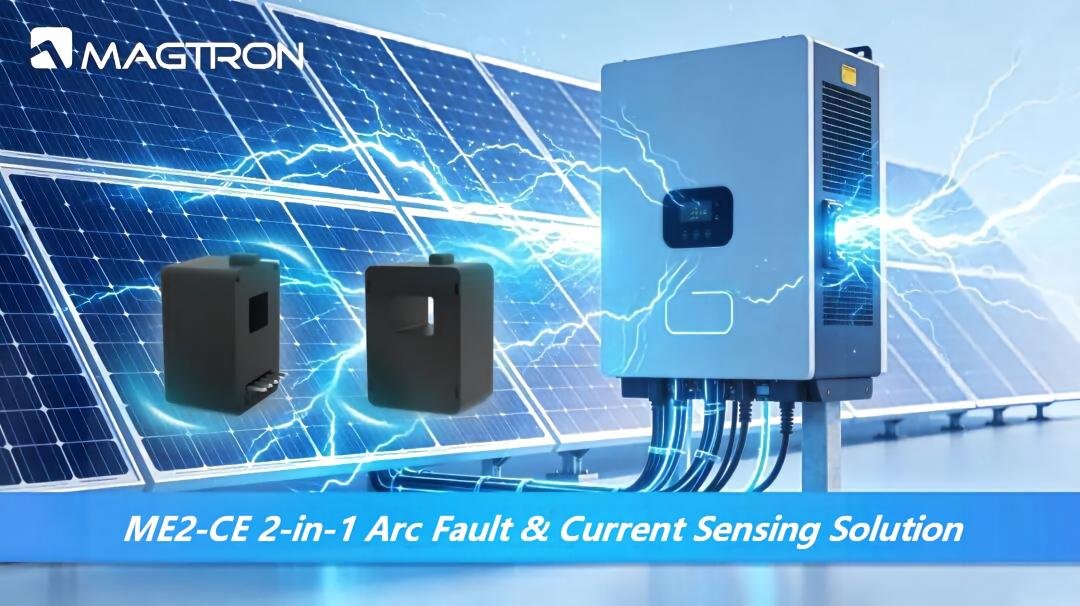
In photovoltaic power generation systems, current measurement runs through various stages of energy conversion and control. From component side current sampling, inverter MPPT control, to grid detection and bidirectional power management of energy storage systems, the accuracy and stability of current signals directly affect system efficiency, safety, and long-term operational reliability. Therefore, how to achieve stable and accurate current measurement under complex working conditions is one of the core issues in the design of photovoltaic power electronics systems.
1、Typical requirements for current sensors in photovoltaic applications
Compared with traditional industrial power sources, photovoltaic systems have the following significant characteristics in current detection:
The current range spans a wide range. From several amperes on the string side to hundreds or even thousands of amperes on the DC busbar, higher requirements are placed on the sensor range, linearity, and magnetic core design.
Long term outdoor operation with harsh environmental conditions. High temperature, temperature cycling, and strong electromagnetic interference are the norm, and current sensors must have good temperature stability and anti-interference ability.
The control algorithm is sensitive to accuracy and response speed. The MPPT algorithm, current loop control, and grid protection all rely on real-time and reliable current data, and zero drift, noise, or delay can directly affect system performance.
In the above context, the selection of current sensors is no longer a simple “range matching”, but a part of system level reliability design.
2、The advantages of closed-loop flux gate technology in high-precision scenarios
In applications that require high measurement accuracy and long-term stability, closed-loop flux gate current sensors are widely used in key detection links of photovoltaic inverters. The core working principle is to excite the magnetic core into a periodic saturation state and use a feedback coil to compensate for the magnetic flux generated by a current in real time, so that the magnetic core always operates in a near zero magnetic flux state.
The direct advantages brought by this closed-loop structure include:
Excellent linearity and repeatability. The measurement result is directly proportional to the current height, which is suitable for applications such as MPPT control that are sensitive to small changes.
Low zero drift and low temperature coefficient. Stable output can still be maintained within a wide temperature range, reducing calibration deviation during long-term system operation.
Strong resistance to external magnetic interference. In high-power density inverters, it can effectively suppress the effects of stray magnetic fields and common mode noise in the busbar.
Therefore, closed-loop flux gate schemes are often used in scenarios such as DC side current detection, grid side precision sampling, and energy metering in energy storage systems.
3、The practical value of open-loop Hall scheme in engineering applications
In some cost sensitive or space limited photovoltaic devices, open-loop Hall current sensors still have irreplaceable engineering advantages. The structure of this scheme is relatively simple, and current measurement is achieved by inducing magnetic field changes through Hall elements. It has fast response speed, low power consumption, and is easy to integrate.
To address common shortcomings in photovoltaic applications, such as temperature drift and decreased accuracy in low current areas, the following measures can be taken to improve:
a. Choose magnetic core materials with low hysteresis and high saturation magnetic flux density
b. Adopting temperature compensation circuit and optimized signal conditioning design
c. Reduce external magnetic field coupling through structural optimization
In applications such as overcurrent protection, power monitoring, and high current busbar detection, the open-loop Hall scheme achieves a good balance between performance and cost.
4、 From a system perspective, the selection logic of current sensors
In the design of photovoltaic systems, current sensors should not be viewed in isolation, but should be comprehensively evaluated based on control strategies, power topology, and overall lifespan goals. For example, for high-precision control circuits, closed-loop flux gate schemes should be given priority consideration; For auxiliary detection or protection functions, an optimized open-loop Hall scheme can be used; In new inverters with high frequency and high dv/dt, special attention should be paid to the anti-interference ability and dynamic response of sensors.
Reasonable technology selection can reduce system debugging difficulty, improve overall consistency and reliability while ensuring performance.
Conclusion
With the development of photovoltaic systems towards higher power density and higher efficiency, the importance of current measurement technology will be further highlighted. Based on a deep understanding of photovoltaic application scenarios, we continuously optimize the design and process of flux gates and Hall current sensors, striving to achieve the best balance between accuracy, stability, and engineering applicability, providing a solid data foundation for the safe and reliable operation of photovoltaic systems.