Insulation monitoring on the DC side of photovoltaics is the lifeline of power station safety. Its core task is to stably extract weak leakage current signals at the microampere level from a common-mode voltage background as high as 1500V, and accurately calculate insulation resistance at the megaohm level based on this. This “microvolt probe” task is severely interfered by ubiquitous distributed capacitance and the capacitive current it induces in real power station environments. Traditional insulation monitoring devices based on low-frequency injection frequently misalign in this scenario. The fundamental contradiction lies in: increasing the injection frequency to penetrate the capacitive “shield” simultaneously amplifies system noise; amplifying signals to improve sensitivity introduces more severe interference. This paper focuses on this core engineering conflict, analyzes the quantitative mechanism of measurement failure caused by distributed capacitance, and explores how to establish a new technical balance between μA-level signal capture and anti-submersion risk.
I. Core Interference Source: Time-Varying Characteristics of Photovoltaic Array Distributed Capacitance
The distributed capacitance of photovoltaic modules to the ground and brackets is not a fixed value but a time-varying interference source dominated by the environment.
Humidity Sensitivity of Capacitance Value
Under dry conditions, the capacitance of modules to the ground is approximately 50-100nF per kilowatt. In rainy or high-humidity environments, the formation of water films can increase the capacitance by 5-10 times. This means the capacitive reactance changes drastically with weather, and IMDs using fixed frequencies and fixed compensation parameters cannot adapt.
“Submersion” of Injection Signals by Capacitive Current
IMDs typically inject a low-frequency AC test voltage (e.g., ±15V) of 1-10Hz into the DC bus. The theoretical test current generated is Itest = Vtest / Ztotal, where Ztotal is the parallel impedance of insulation resistance Riso and distributed capacitance Cpv. On humid days (with increased Cpv), the capacitive reactance Xc at low frequencies is much smaller than Riso, so Itest is shunted by the capacitor, resulting in an extremely weak resistive current signal flowing through Riso and a very low signal-to-noise ratio.
Frequency Band Overlap Pollution by PWM Switching Noise
The PWM voltage of the inverter’s front-end Boost circuit generates capacitive coupling current through Cpv. This current is completely separated from the low-frequency signal injected by the IMD in the frequency domain, seemingly causing no interference. However, in actual non-ideal systems, the rising edges of PWM and ringing caused by parasitic parameters may have their frequency spectra extended downward to the IMD’s detection band, forming an intractable background noise floor.
II. Failure Boundaries and Contradictions of Traditional Schemes
1. Inherent Defects of the Low-Frequency Injection Method
Deadlock between response speed and sensitivity: To reduce the impact of Cpv, theoretically, the injection frequency needs to be infinitely reduced, but this results in a single measurement cycle as long as tens of seconds, failing to meet the requirements of rapid monitoring. At the same time, ultra-low-frequency signals are more susceptible to 1/f noise interference.
Insoluble fault location: Low-frequency signals suffer severe propagation attenuation in large DC networks and cannot be effectively located using phase information. An insulation fault in one branch will be “averaged out” by the Cpv of the entire system, causing the IMD to only alarm the overall insulation degradation of the system but fail to identify the faulty branch.
2. Application Limitations of the Voltage Unbalance Method
The method of calculating insulation resistance by measuring the positive and negative pole voltages to the ground has significant errors when the DC system is operating under load. The MPPT operation of the inverter dynamically changes the operating point in real time, leading to dynamic fluctuations in U+ and U-. These fluctuations are much larger than the voltage offset caused by insulation faults, making this method basically ineffective during power station operation and only suitable for shutdown maintenance.
III. Breakthrough Paths: Multi-Frequency Impedance Spectroscopy Analysis and Active Noise Suppression
1. Impedance Spectroscopy Analysis (ISA) from Single-Frequency Measurement to Multi-Frequency Scanning
This is a fundamental method to solve Cpv interference. The IMD injects a set of test signals with different frequencies into the system and synchronously measures the response current at each frequency.
Decoupling Riso and Cpv: By measuring data at least two different frequency points, two independent parameters—insulation resistance Riso and ground capacitance Cpv—can be solved simultaneously, thereby accurately separating the resistive leakage current from the huge capacitive current. This makes the measurement results no longer affected by weather humidity.
Establishing a capacitive reactance baseline: Continuous monitoring of historical Cpv data can establish a normal model of its variation with humidity. When the Cpv value mutates abnormally while Riso remains unchanged, it may indicate a change in the physical structure, providing a new early warning dimension.
2. Ultimate Design and Anti-Submersion Strategies for μA-Level Signal Chains
High-precision magnetic modulation sensing technology: Measuring the total leakage current on the ground wire requires the sensor to have better resolution and long-term stability under ampere-level power frequency or DC components. Traditional Hall sensors or transformers are difficult to meet this requirement. Closed-loop fluxgate technology has become the first choice due to its near-zero offset and extremely low noise density.
Synchronous detection and digital lock-in amplification: While injecting a test signal of a specific frequency, a digital lock-in amplifier is used at the detection end. Its reference frequency is strictly synchronized with the injected signal, which can “lock” and extract signal energy from wideband noise, greatly improving the signal-to-noise ratio. Even if the effective signal is submerged dozens of times, it can be reliably detected.
Active PWM synchronization and “silent window” sampling: Communicating with the inverter controller, the injection and measurement periods of the IMD are strictly arranged at fixed phase points of the inverter’s PWM switching or within a short “silent window”. This fundamentally avoids the largest switching noise source.
3. System-Level Integration and Positioning Enhancement
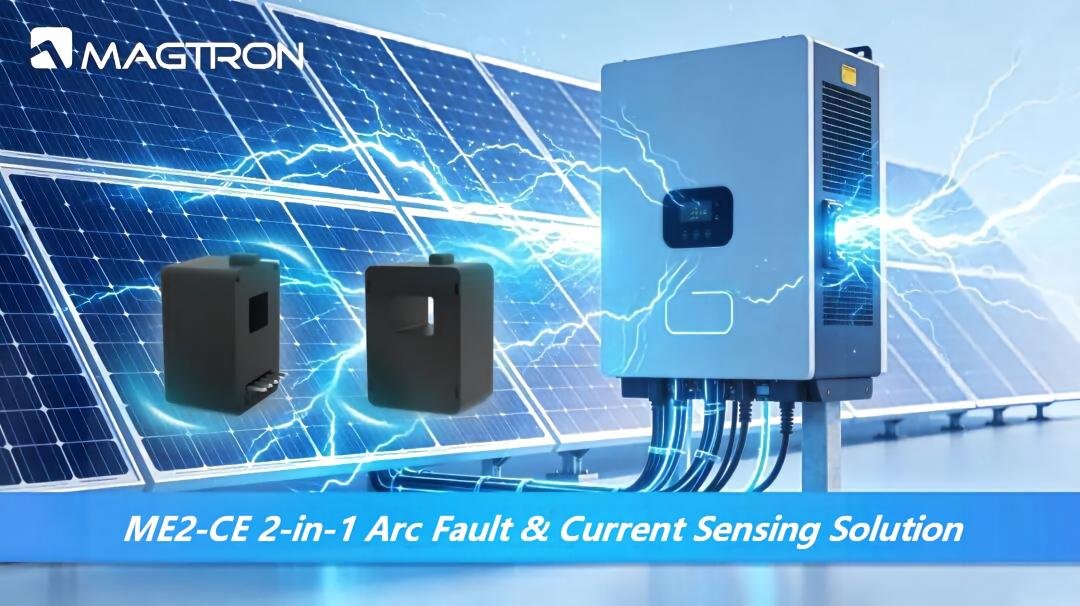
Sensor reuse for IMD and DC arc detection: AFCI needs to monitor MHz-level high-frequency noise. Its sensor and the IMD’s sensor can be considered for integrated design, sharing the magnetic core and sampling channel. Low-frequency insulation signals and high-frequency arc characteristics are separated through digital signal processing, reducing hardware costs.
Branch-level differential measurement positioning: Install high-precision micro-current sensors at the outlet of each branch in the combiner box. When the system IMD detects an overall insulation degradation, it activates each branch sensor to synchronously measure the small differences in their leakage currents. The leakage current of the faulty branch will be significantly larger than that of normal branches, thereby achieving branch-level fault positioning and reducing the maintenance scope from the entire power station to a single cable.
IV. Conclusion: Upgrade from “Fault Alarm” to “Condition Assessment”
The technological evolution of photovoltaic DC insulation monitoring is transforming from a simple “threshold alarm device” to a complex “system insulation condition assessment instrument”. Its core challenge has shifted from how to measure a resistor to how to stably extract μA-level micro-varying signals in a harsh electromagnetic environment with strong capacitive coupling, high common-mode voltage, and wideband noise.
Overcoming this challenge relies on multi-frequency active detection to resolve complex impedances, fluxgate-level precision sensing to capture weak signals, and collaboration with the main inverter system to avoid major interference. This means that insulation monitoring is no longer an independent protection device but must be deeply integrated into the overall electrical architecture and communication protocols of the photovoltaic system.
Ultimately, a successful insulation monitoring solution will provide not just a simple “pass/fail” signal, but a comprehensive condition report including the accurate value of insulation resistance, the health trend of distributed capacitance, fault branch positioning information, and risk prediction. This transforms the DC-side safety management of photovoltaic power stations from passive post-fault handling to proactive pre-fault risk prediction and precise operation and maintenance, building a truly intelligent, data-driven core defense line for the safe operation of power stations for decades.