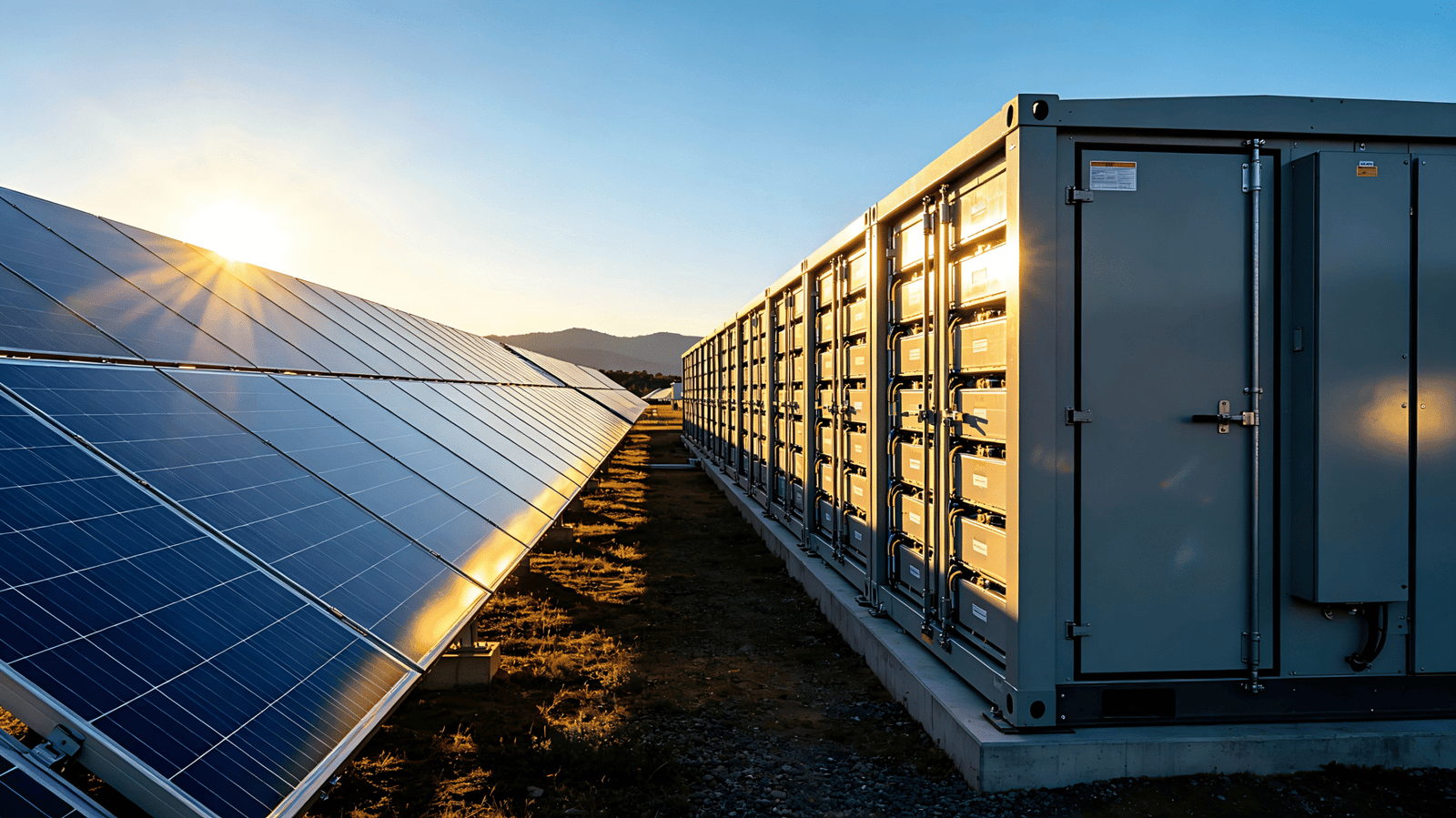
The global energy transition is increasingly converging on a single architecture: solar-plus-storage.
From utility-scale plants in inland Australia, to commercial rooftops in Germany, to residential systems in California, the combination of photovoltaic (PV) generation and battery energy storage systems (BESS) has become the standard blueprint for dispatchable renewable power.
Yet while most industry attention is focused on panel efficiency, battery chemistry, and inverter topology, a quieter technical battle is unfolding deep inside system hardware—one that will ultimately determine whether these systems can deliver on their promised 20–25 year lifespans.
At the center of that battle lies current sensing accuracy.
1. The Critical Math: Why a 1% Error Is Unacceptable
In any energy storage system, a battery management system (BMS) is only as good as the data it receives.
State of Charge (SOC) and State of Health (SOH)—the two core metrics governing dispatch, warranty compliance, and revenue optimization—are fundamentally derived from integrating current over time.
A seemingly small 1% current measurement error does not remain 1%. Due to the nature of coulomb counting, it accumulates.
Over months or years of operation, 5–10% SOC drift is common, leading to:
- Premature cell degradation due to overcharge or deep discharge
- Usable capacity reduction as operators add safety margins
- Grid dispatch failures caused by incorrect energy availability estimates
For utility-scale operators participating in frequency regulation or peak shaving markets, SOC uncertainty directly translates into lost revenue and contractual penalties.
2. Three Core Challenges in Solar + Storage Sensing
Current measurement in integrated PV + storage systems is deceptively complex. Engineers must simultaneously solve three constraints:
1) Wide Dynamic Range
A residential battery may sit near zero current for hours, then suddenly demand 100A or more during peak discharge.
Sensors must maintain accuracy across a 1:1000 dynamic range, without losing resolution at the low end.
2) Bidirectional Measurement with Microsecond Response
Current flow constantly reverses:
- PV charging the battery
- Battery supplying loads or the grid
- Grid transients requiring immediate isolation
Sensors must support bidirectional measurement and respond within microseconds to protect contactors and power semiconductors.
3) Long-Term Drift Under Thermal Stress
Outdoor systems experience ambient temperatures from -40°C to +85°C, plus internal self-heating.
Any offset drift or gain drift becomes a permanent systematic error in BMS calculations.
3. Technology Comparison: Shunt vs Hall vs Fluxgate
Three main sensing technologies dominate the market, each with clear trade-offs:
| Technology | Accuracy | Isolation | Temperature Drift | Power Loss | Best Fit |
|---|---|---|---|---|---|
| Shunt Resistor | Very High | Poor (needs isolation amplifier) | Moderate | High (I²R loss) | Low-voltage, cost-sensitive designs |
| Hall Effect | Moderate | Good | High (offset drift, hysteresis) | Low | Mid-range inverters, non-critical BMS |
| Fluxgate | Very High | ممتاز | Very Low | Low | High-precision BMS, grid-tied systems, harsh environments |
Hall-effect sensors dominate mass markets due to compact size and low cost. However, their reliance on magnetic materials with nonlinear B-H curves introduces hysteresis errors and temperature-dependent offset drift.
Over a 15-year lifecycle with daily cycling, these errors accumulate unpredictably.
Shunt resistors offer excellent linearity but introduce power loss and system complexity, especially in high-voltage battery stacks.
Fluxgate sensing operates on a fundamentally different principle. By driving a high-permeability core into periodic saturation and detecting symmetry modulation caused by external current, it achieves a true zero-flux operating point, eliminating DC offset at its source.
When combined with integrated ASICs—handling excitation, temperature compensation, and signal processing—modern fluxgate sensors can deliver:
- ≤0.5% accuracy (typically 0.1%)
- 100 kHz bandwidth
- 1 μs response time
- Stable performance across full automotive/industrial temperature ranges
4. Application Scenarios
Scenario 1: String-Level Monitoring & MPPT Optimization
On the PV side, string current sensors serve two key functions:
- Fault detection (soiling, shading, diode failure, hot spots)
- Input to Maximum Power Point Tracking (MPPT)
MPPT controllers rely on accurate current to compute power (P = V × I). Any delay or drift causes the inverter to chase a false maximum power point, wasting harvestable energy.
In large PV plants, even a 0.5% MPPT efficiency loss can translate into hundreds of MWh annually.
Scenario 2: Grid-Tied Inverter Control & Power Quality
As distributed PV and storage penetrate deeper into the grid, utilities are tightening power quality requirements:
- Total Harmonic Distortion (THD)
- Reactive power control
- Anti-islanding protection
All of these depend on accurate real-time reconstruction of grid current waveforms.
This requires:
- Bandwidth beyond 50/60 Hz fundamentals (typically >50 kHz)
- Low phase delay for loop stability
Fluxgate sensors, with wide bandwidth and linear phase response, are increasingly adopted in next-generation inverter designs, including three-level topologies and solid-state transformer systems.
Scenario 3: BESS Coulomb Counting & Cell Formation
In battery manufacturing, formation and grading is one of the most energy-intensive steps.
Current sensors in formation equipment must achieve ±0.1% accuracy or better to correctly classify cells.
Inaccurate sensing can:
- Reject good cells
- Or worse—pair mismatched cells into modules, leading to long-term safety and lifespan issues
For deployed BESS systems, the requirement remains the same.
Modern LFP cells operate on extremely flat voltage curves, leaving little voltage-based SOC correction. Current measurement becomes the primary source of truth.
5. From Component to System Enabler
What’s changing now is integration.
Fluxgate sensing was once limited to laboratory and aerospace applications. With ASIC integration, it is now entering mainstream energy infrastructure.
A single chip can integrate:
- Excitation oscillator
- Precision analog front-end
- Digital temperature compensation
- Output drivers
This significantly reduces size, cost, and calibration effort—bringing fluxgate solutions closer to Hall-effect competitiveness.
For system integrators and EPCs, the implication is clear:
Current sensor selection is no longer a minor BOM decision.
It is:
- A 20-year reliability decision
- A warranty decision
- A revenue decision
6. Conclusion
The solar-plus-storage industry is entering a new phase of maturity.
The era of “good enough” engineering is ending.
As asset owners scrutinize degradation curves, insurers model fire risk, and grid operators enforce tighter dispatch accuracy, every subsystem is under pressure to perform.
Current sensing sits at the intersection of:
- Safety
- Efficiency
- Lifetime performance
Technologies that deliver:
- High accuracy
- Wide dynamic range
- Fast bidirectional response
- Thermal stability
will define the next generation of PV and BESS systems.
Because ultimately, the most valuable sensor is the one precise enough to be forgotten—quietly ensuring that:
- Every electron is counted
- Every cycle is optimized
- Every system outperforms its warranty