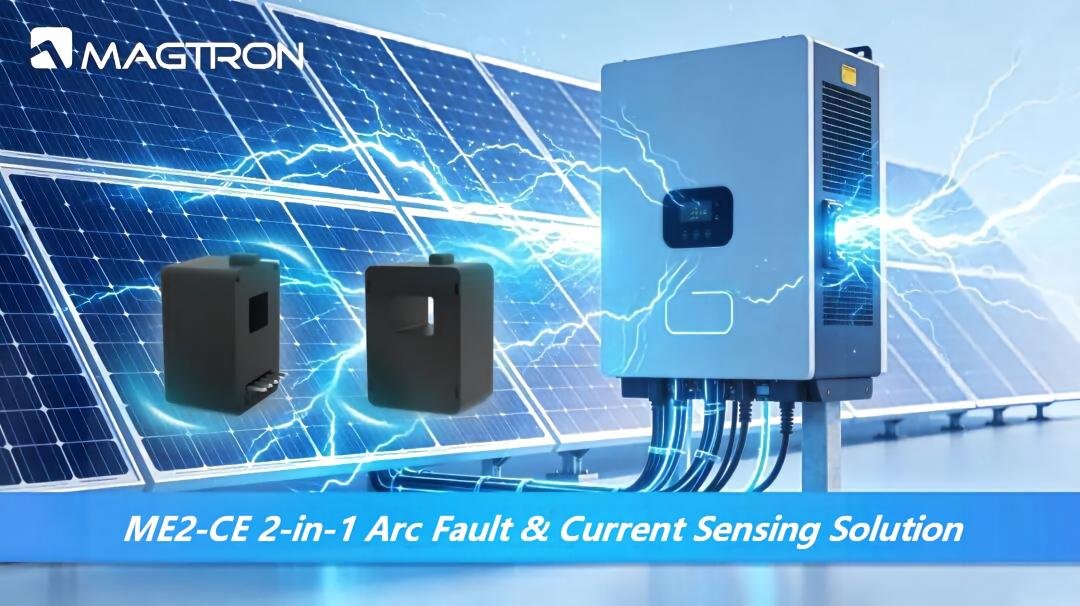
With the increasing demand for measurement accuracy and long-term stability in photovoltaic systems, the application of closed-loop flux gate current sensors in inverters and energy storage systems is gradually increasing. However, in practical engineering, flux gates are not a “universal solution”. Only by clearly understanding its applicable boundaries can the value of this technological route be truly realized.
1、 What are the advantages of closed-loop flux gates
The closed-loop flux gate applies periodic excitation to the magnetic core and introduces feedback compensation current, allowing the magnetic core to operate in a near zero flux state for a long time. Due to the fact that the magnetic core does not withstand the DC bias caused by the measured current, its linearity, zero stability, and temperature characteristics are significantly better than the open-loop scheme.
In photovoltaic systems, this advantage is particularly reflected in the precise measurement and key nodes involved in control and measurement on the DC side. For example, MPPT algorithm, current loop control, and energy statistics all rely on stable and reproducible current signals. In these applications, closed-loop flux gates can provide a more reliable data foundation.
2、 Applicable scenario 1: Measurement points in low current areas and with high long-term operation requirements
Photovoltaic systems do not operate at rated power points for a long time, and low light and partial load conditions occupy a significant amount of operating time. Under this condition, the low current performance of current measurement becomes the determining factor for system stability.
Closed loop flux gates have significant advantages in zero drift and low current resolution, making them more suitable for measurement points that are sensitive to low current changes and require long-term data reliability. For systems that require consistency after years of operation, this feature has practical significance.
3、 Applicable boundary one: Power density and space constrained conditions
Closed loop flux gates typically have relatively complex structures and certain requirements for magnetic core size, excitation coils, and compensation circuits. In inverters with continuously increasing power density, the internal space is becoming increasingly tight, and the volume and heat dissipation conditions of sensors have become important constraints.
In highly integrated scenarios, if reasonable installation space and heat dissipation environment cannot be guaranteed, the advantages of flux gates may be difficult to fully utilize, and even introduce new thermal stability issues. In such scenarios, it is necessary to comprehensively evaluate the structural conditions and measurement requirements, rather than making decisions based solely on performance indicators.
4、 Applicable boundary two: high-frequency and large dynamic current scenarios
The working mode of the closed-loop flux gate determines that its dynamic response is limited by the compensation loop and excitation frequency. In scenarios that require extremely high bandwidth or are highly sensitive to transient changes, their response speed may not be as fast as simpler structured solutions.
In photovoltaic systems, overcurrent protection and rapid fault detection often emphasize response speed rather than long-term accuracy. For such functional measurement points, closed-loop flux gates may not necessarily be the optimal choice.
5、 Implicit boundaries at the engineering level
Closed loop flux gates are sensitive to power supply quality, layout rationality, and system interference environment. If the power supply noise is high, the grounding design is unreasonable, or the external magnetic field is complex, the compensation circuit may bear additional burden, affecting overall stability.
In addition, in large-scale applications, its cost and consistency control also need to be included in system evaluation, rather than simply starting from single point performance.
Conclusion
The value of closed-loop flux gates in photovoltaic scenarios is reflected in their good matching of low current, long-term stability, and high consistency requirements. But this technological route is not applicable to all measurement nodes. Only by fully understanding the system’s functional requirements, structural constraints, and dynamic characteristics, clarifying its applicable boundaries, and carrying out reasonable division of labor, can the overall optimal current measurement scheme be achieved in complex photovoltaic systems.