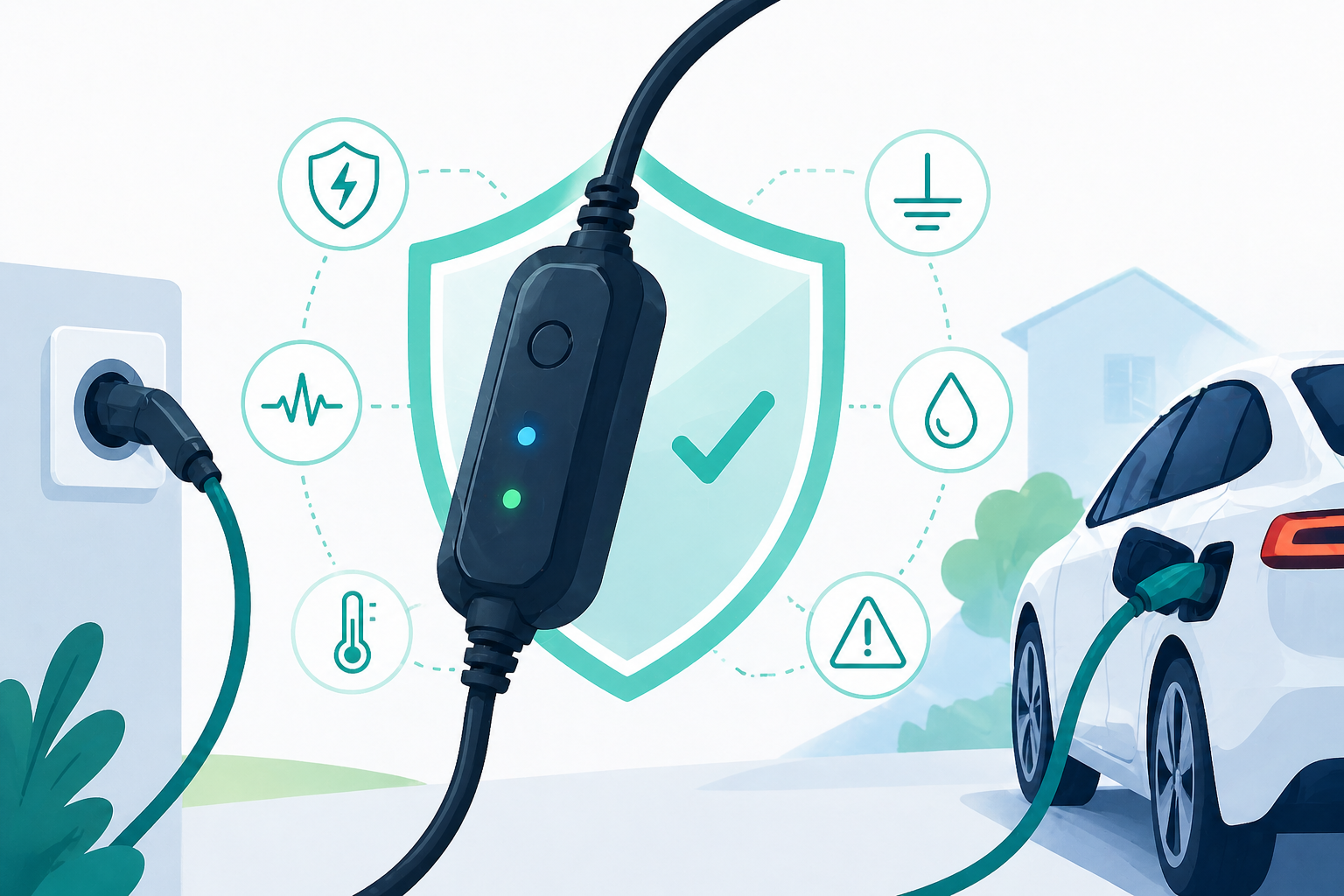
Mode 2 portable EV charging relies on an IC-CPD (In-Cable Control and Protection Device) to connect directly to standard household outlets. Thanks to its plug-and-play convenience and flexible deployment, it has become the mainstream solution for portable EV charging worldwide. IEC 62752, the dedicated international safety standard for Mode 2 IC-CPD, clearly defines protection boundaries, performance requirements, and compliance criteria. It serves as the core reference for global IC-CPD design, manufacturing, and market access. This article breaks down the key protection logic defined in IEC 62752 and provides professional guidance for selecting core sensing components based on real-world application needs.
1. IEC 62752 and Mode 2 IC-CPD: Standard Positioning and Application Value
Mode 2 charging is designed for AC circuits up to single-phase 250V and three-phase 400/480V, with rated currents up to 32A. It supports both 50Hz and 60Hz grid frequencies, making it suitable for global use. It is widely adopted for residential and temporary outdoor charging scenarios.
IC-CPD is not just a cable—it is an integrated safety unit combining residual current monitoring, overcurrent protection, control pilot signaling, and fault interruption. It serves as the only protective layer between a standard household socket and the onboard charger (OBC).
IEC 62752, officially titled “Electric vehicle requirements for in-cable control and protection device for mode 2 charging”, is published by the International Electrotechnical Commission (IEC). It fills the safety gap where standard household outlets lack dedicated EV charging protection. Working in coordination with standards such as IEC 61851 and IEC 62955, it comprehensively addresses risks including electric shock, equipment overload, electrical fire, and grid compatibility. Compliance with IEC 62752 is mandatory for IC-CPD products entering the global market.
2. IEC 62752 Requirements: Five Core Protection Functions for IC-CPD
1. 6mA DC Residual Current Protection (Mandatory Core Requirement)
During operation, EV onboard chargers (OBCs) may generate smooth DC residual currents. Traditional AC residual current devices can fail due to magnetic saturation, leading to missed trips or false triggering. IEC 62752 mandates that IC-CPD must accurately detect and quickly disconnect at 6mA DC residual current, while also covering sinusoidal AC and pulsating DC residual currents. This is the most critical and non-negotiable requirement of the standard.
2. Overcurrent, Short-Circuit, and Plug Overtemperature Protection
Household outlets have limited current-carrying capacity. Loose connections, aging wiring, or overload conditions can cause abnormal current and overheating, potentially leading to melted sockets or cable fires. IEC 62752 requires real-time current monitoring and rapid disconnection under fault conditions, along with plug temperature monitoring to prevent thermal hazards at the source.
3. Grid Voltage Abnormality Protection
Voltage fluctuations in the grid can directly damage the onboard charger and battery system. IC-CPD must continuously monitor supply voltage and immediately suspend charging when voltage exceeds safe limits, preventing irreversible damage caused by voltage surges.
4. Self-Test and Protection Failure Detection
To avoid “hidden failures” in protection components, IEC 62752 requires continuous self-diagnostic capability. The IC-CPD must monitor the status of sensing, control, and switching units in real time. If any failure is detected, charging must be disabled immediately and a fault signal must be issued.
5. Reliable Operation Under Strong Electromagnetic Interference (EMI)
High-frequency electromagnetic interference generated by onboard power electronics can cause false triggering or missed detection. IEC 62752 requires residual current protection devices to maintain accuracy and response speed under complex EMI conditions, ensuring reliable operation during faults.
3. Key Technical Requirements for Core Sensing Components
Residual current sensors are the core components enabling IC-CPD protection functions. To meet IEC 62752 compliance and performance requirements, they must satisfy the following criteria:
- Protection Type: Support Type A + 6mA DC or Type B, covering all residual current detection scenarios
- Operating Temperature: Wide range of -40°C to +85°C for reliable operation across global climates
- Power Supply: Single 5V supply, simplifying compact and lightweight IC-CPD design
- Current Capacity: Compatible with mainstream Mode 2 charging power levels (3.3kW / 7kW / 22kW)
- Certifications: International certifications required for global market access
- Functional Features: Integrated self-test, stable signal output, and strong EMI immunity
4. IC-CPD Compliance Selection: Sensor Solutions for IEC 62752
To meet IEC 62752 requirements for Mode 2 IC-CPD applications, the MAGTRON RCMU switching-type residual current sensor series—based on proprietary iFluxgate® technology and SoC design—offers a proven and reliable solution.
These sensors feature modular PCB mounting and are only one-quarter the size of traditional solutions, aligning with the trend toward compact and portable IC-CPD designs. Key models include:
- RCMU101SM1-2EI-K: +5V supply, -40°C to +85°C operation, max current 20A, suitable for 3.3kW single-phase IC-CPD, supports Type A + 6mA DC protection
- RCMU101SM3-6EI-K: Max current 42A, designed for 7kW single-phase charging, with enhanced protection and current capacity
- RCMU101SN-E Series: Aperture options of 12.8mm / 20mm, supporting up to 22kW single-phase or three-phase charging, suitable for high-power IC-CPD designs
These products are certified by internationally recognized bodies including CE, UL, TÜV, DEKRA, and SGS, and comply with RoHS and REACH environmental regulations. Their wide temperature tolerance and strong EMI resistance make them suitable for diverse global charging environments, accelerating IC-CPD deployment worldwide.
5. Conclusion
IEC 62752 defines the safety baseline and compliance threshold for Mode 2 IC-CPD products. Centered on three key areas—personal safety, equipment protection, and grid compatibility—it establishes comprehensive protection requirements.
When selecting core components for IC-CPD, prioritizing residual current sensors that support 6mA DC detection, integrated self-testing, wide temperature stability, and full international certification is essential to ensure compliance, safety, and reliable operation.
The MAGTRON RCMU series, with its precise standard alignment, broad power coverage, and robust environmental adaptability, provides a dependable protection core for global Mode 2 IC-CPD applications—making portable EV charging safer and more compliant.